

Ever wondered how US presidential elections impact the stock market? In this article, we explore historical trends, stock market forecasts, and Bitcoin price movements under different administrations.
With the US election just days away, you might be curious about which party could be more favorable for Bitcoin mining stocks. Several popular studies examine the relationship between the overall stock market and US elections.
The S&P 500’s Predictive Power in US Elections
The S&P 500 has a remarkable ability to “predict” presidential election outcomes. According to LPL Financial, the index has accurately forecasted the winner in 20 out of the last 24 elections.
The pattern works like this: when the S&P 500 has posted positive returns in the three months leading up to an election, the incumbent party has won the White House 12 out of 15 times. Conversely, when the index has shown negative returns during that period, the incumbent party has lost 8 out of the last 9 times.
This year, with the S&P 500 trending upward, historical patterns might suggest a win for the incumbent party if this trend continues. However, caution is warranted; today’s political landscape is more unpredictable than ever. For instance, the 2020 election broke this trend when Donald Trump lost to Joe Biden, even though the S&P 500 rose by 2.3% in the months leading up to the election.
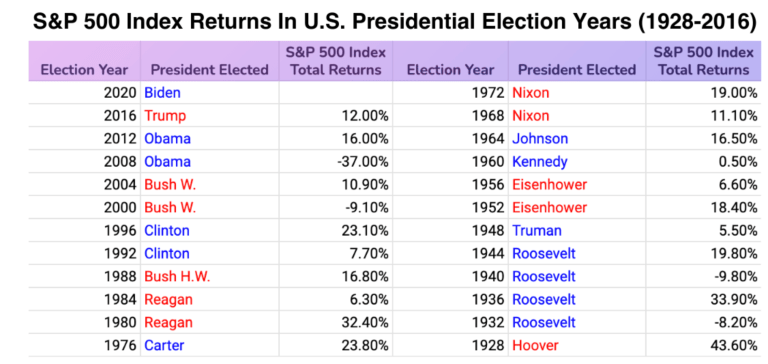
S&P 500 Index Returns During US Presidential Election Years

According to a report from Morgan Stanley, the S&P 500 has historically shown gains in most election years, with positive returns in 83% of the 23 election years since its inception. This data suggests that, regardless of which party wins, election years tend to be beneficial for the S&P 500. However, it’s essential to note that historical performance does not guarantee future results. Market reactions are highly contingent on specific economic conditions, policy changes, and external factors unique to each election year.
Bitcoin Price Changes During US Presidential Election Years
Inspired by the historical returns of the S&P 500 during election years, I analyzed Bitcoin price movements across different election cycles. The reason for studying Bitcoin prices is their strong correlation with Bitcoin mining stocks. While both exhibit volatility, mining stocks often experience larger price swings than Bitcoin.
Key Bitcoin price trends during election years include:
-2012 Election (Obama): Bitcoin started at $4.72 and rose to $430.57 by December 31, 2015, with a median price change of 110.99%.
-2016 Election (Trump): Bitcoin began at $368.77 and surged to $7,193.60 by December 31, 2019, resulting in a median price change of 134.69%.
-2020 Election (Biden): Bitcoin opened at $7,200.17 and climbed to $42,265.19 by December 31, 2023, yielding a median price change of 54.87%.
While Bitcoin has experienced substantial growth over the years, linking its price solely to election outcomes oversimplifies the broader picture. Bitcoin’s growth is driven by global adoption, technological advancements, and decentralized market dynamics, making it less reliant on specific political administrations compared to traditional stocks.
Limitations of Using Election Data to Predict Bitcoin Trends
Bitcoin’s decentralized nature limits the predictive power of US election cycles. Without direct ties to any one country’s political system, Bitcoin evolves alongside global demand, technology, and macroeconomic factors. As a result, while election years may introduce volatility in Bitcoin prices—and by extension, Bitcoin mining stocks—the cryptocurrency’s long-term growth trend is only minimally influenced by political changes.
Long-Term Perspective: Stay Focused on the Bigger Picture
Let’s be honest: forecasting the market based on election results can be as reliable as predicting next year’s weather. Historically, the US stock market tends to rise during most presidential terms, regardless of party affiliation. According to Darrow Wealth Management, political gridlock—where different parties control the presidency, Senate, and House of Representatives—can often lead to the best outcomes for markets. Why? It limits significant policy changes, allowing businesses to operate without facing major uncertainties.
In fact, stock returns typically increase over time—unless disrupted by a financial crisis or other significant shocks. While election years may add an element of excitement, the best strategy is to focus on the long-term trends.
Bitcoin and its mining stocks introduce a unique dimension to this narrative. Unlike traditional stocks, Bitcoin is not directly tied to the US political framework, and its decentralized nature enables it to thrive regardless of the political climate. This resilience emphasizes the importance of maintaining a broad perspective. Bitcoin’s price will undoubtedly fluctuate, and mining stocks will follow suit, but the long-term trend has remained positive.
At The End
Speculation during election years can be thrilling, but political figures come and go. The markets, however, have a long-term history of resilience. Whether it’s Bitcoin or the stock market, they will forge their own paths, regardless of who occupies the Oval Office.
